
Implementation of a multi-friction remote laboratory based on IoT strategies and estimation models
Article Sidebar
Main Article Content
Abstract
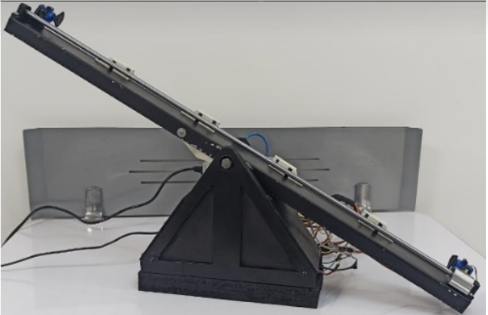
This paper presents the implementation of a multi-friction remote laboratory (RL) in the inclined plane study. We use an IoT and software strategy. For the design we start from the pedagogical objectives of a standardized teaching process, and we propose a mathematical model that has the possibility of generating changes by software, to ensure the reproducibility of a physical phenomenon. Finally, we considered the technical and statistical validation of the experiment. The results show the flexibility of the method to reproduce the friction effect with different types of material, without the need to make physical variations on the device and without generating changes that can be perceived by the user who uses the device.
Article Details
References
Abadía, A. (2022). Diálogo sobre el impacto de la pandemia en la educación superior y la transformación digital de las universidades en Iberoamérica - SEGIB. From https://www.segib.org/dialogo-sobre-el-impacto-de-la-pandemia-en-la-educacion-superior-y-la-transformacion-digital-de-las-universidades-en-iberoamerica/
Albert Gómez, M., García Pérez Calabuig, M., y Díaz Orueta, G. (2016). La evaluación como instrumento de formación para el aprendizaje a través de los laboratorios remotos. REDU. Revista De Docencia Universitaria, 14(1), 377. Doi: 10.4995/redu.2016.5788.
Andrés, M., Pesa, M. A., y Meneses, J. (2006). La actividad experimental en física: visión de estudiantes universitarios. Paradigma, 27(1), 349-363.
ASM Handbook, Volume 18, Friction, Lubrication, and Wear Technology. Estados Unidos, 1998.
Bacca. B., Caicedo Bravo. E., Calvache, B., Cardona. J., y Buitrago. J. (2009) Laboratorio distribuido con acceso remoto para la enseñanza de la robótica. En: Revista Educación en Ingeniería, tomo 4, no 7, 2009, págs. 51_69. 1.1, 1.2
Balderas Solís, J., Roque Hernández, R., López Mendoza, A., Salazar Hernández, R., & Juárez Ibarra, C. (2021). ¿Cómo cambió la enseñanza-aprendizaje de las asignaturas prácticas en el área de tecnologías de la información con la covid-19?. RIDE Revista Iberoamericana Para La Investigación Y El Desarrollo Educativo, 11(22). doi: 10.23913/ride.v11i22.826
Bishop, C. M., & Nasrabadi, N. M. (2006). Pattern recognition and machine learning (Vol. 4, No. 4, p. 738). New York: Springer.
Contreras-Mendieta, J. A., Sarango-Lapo, C. P., Jara-Roa, D. I., y Agila-Palacios, M. V. (2019). Implementación de un Laboratorio Remoto (LR), como recurso de apoyo en un sistema de Educación a Distancia. Revista Ibérica de Sistemas e Tecnologías de Información, (E17), 923-935
Domínguez, M., González-Herbón, R., Rodríguez-Ossorio, J., Fuertes, J., Prada, M., y Morán, A. (2020). Development of a Remote Industrial Laboratory for Automatic Control based on Node-RED. IFAC-Papersonline, 53(2), 17210-17215. doi: 10.1016/j.ifacol.2020.12.1741
Hayashi, V., De Almeida, F., Harada, L., Hayashi, F., y Arakaki, R. (2021). Dashboard IoT Remote Lab with MQTT Protocol. Anais Estendidos Do XXVII Simpósio Brasileiro De Sistemas Multimídia E Web (Webmedia 2021). doi: 10.5753/webmedia_estendido.2021.17614
Hufnagel, W. (2015). Manual del aluminio Vol. Barcelona: Reverté.
IMCYC. La importancia de los laboratorios. Revista Ingeniería Construcción y Tecnología, http://www.revistacyt.com.mx/index.php (2018).
Márquez, J. A., y Sanguino, T. M. (2010). Diseño de laboratorios virtuales y/o remotos. Un caso práctico. Revista Iberoamericana de Automática e Informática Industrial RIAI, 7(1), 64-72.
Meza Contreras, L. G., Gallego Becerra, H. A., y Orozco Gallego, H. (2009). Medición de la gravedad empleando el dispositivo "caída libre" con base al microcontrolador pic 16f84a y su correspondiente incertidumbre de medida. Scientia et Technica, 15(42), 248-253.
Ponce, I. (2020). Parametrización de un péndulo simple con una plataforma basada en Arduino. Instituto de Ingeniería y Tecnología.
Serway, R. A., y Jewett, J. W. J. (2015). Física para ciencias e ingeniería (9a. ed. --.). México: Cengage Learning.
Tiempo, C. (2022). Unos 13.000 estudiantes del país dejaron el colegio durante pandemia. August 2022, from https://www.eltiempo.com/colombia/otras-ciudades/desercion-escolar-durante-la-pandemia-en-colombia-529536
UTP, R. Facultad Ciencias Básicas: Contenidos Departamento de Física. https://basicas.utp.edu.co/contenidos-departamento-de-fisica.html (2022).
Vargas, J., Cuero, J., y Torres, C.(2020). Laboratorios Remotos e IOT una oportunidad para la formación en ciencias e ingeniería en tiempos del COVID-19. doi: 10.48082/espacios-a20v41n42p16, 41(42).
Walpole, R. E., Myers, R. H., Myers, S. L., y Ye, K. (2012). Probabilidad y estadística para ingeniería y ciencias. Norma, 162, 157.