
Trilateration and filtering of Wi-Fi RSSI signals as sensors for an indoor positioning system.
Article Sidebar
Main Article Content
Abstract
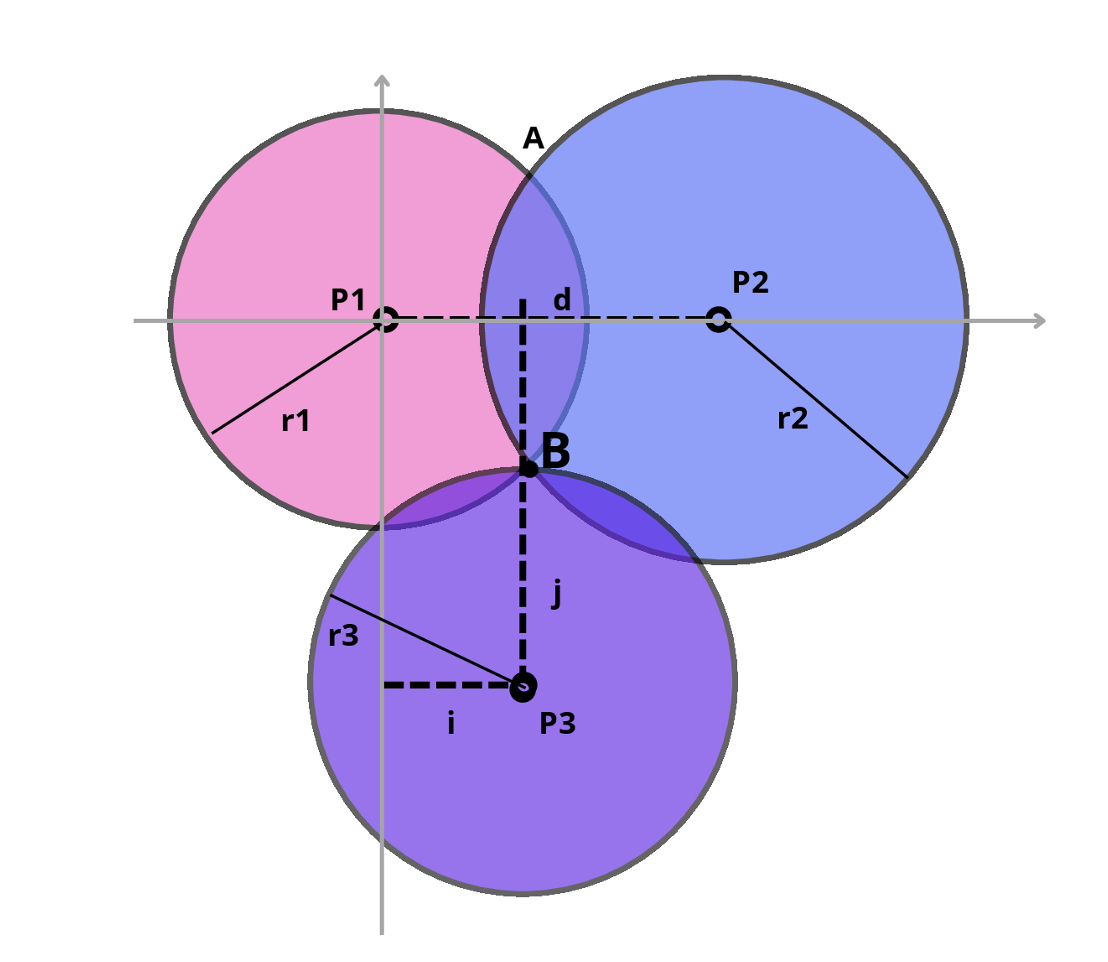
This work investigates the feasibility of using the RSSI signal emitted by Wi-Fi devices (Beacons) as sensors for locating items indoors. Although there are reported works in the literature that use RSSI signals, they are complex and costly due to the high interference that this type of signal presents and the need to combine different techniques to minimize interference. The technique proposed in this work presents the application of a signal filtering method, the Kalman filter, which allows improving the readings of the RSSI signals of the devices used in the tests. To reduce the complexity of the system, the trilateration location method is used, which uses the estimation of the distances between three fixed devices, called reference nodes, to a scanning device, called the target node, which is the element to locate; using for this the relationship between distance and the RSSI signal emitted by WiFi devices. Finally, a sampling of the tests carried out is presented and the effectiveness of determining the location of an object indoors through the use of the proposed system is observed, with the main conclusion of this work being that the proposed system with economical hardware, allows you to make practical rough estimates of which section or room the item is in.
Article Details
References
Bulten, W., Rossum, A. C. V. and Haselager, W. F. G. (2016). Human SLAM, Indoor Localisation of Devices and Users. IEEE First International Conference on Internet-of-Things Design and Implementation (IoTDI), 211-222. https://doi.org/10.1109/IoTDI.2015.19
Bulten, W. (2015). Kalman filters explained: Removing noise from RSSI signals. Available at: www.wouterbulten.nl/blog/tech/kalman-filters-explained-removing-noise-from-rssi-signals. Accessed: September 24, 2021.
Clar, M., Ramos, R. and Suriñach, J. (1998). Latent Variable Model to Measure Regional Manufacturing Production in Spain. Workshop on Regional Economic Indicators. Braga, Portugal: University of Minho, Workshop on Regional Economic Indicators.
Dahlgren, E. y Mahmood, H. (2014). Evaluation of Indoor Positioning Based on Bluetooth Smart Technology. Master Thesis, Chalmers University of Technology, Goteborg, Sweden.
Fard, H. K., Chen, Y. and Son, K. K. (2015). Indoor positioning of mobile devices with agile iBeacon deployment. IEEE 28th Canadian Conference on Electrical and Computer Engineering (CCECE '15), 275-279. https://doi.org/10.1109/CCECE.2015.7129199
Nicholas, G., & Shapiro, A. (2021). Failed hybrids: The death and life of Bluetooth proximity marketing. Mobile Media & Communication, 9(3), 465–487. https://doi.org/10.1177/2050157920975836
Windarni, V. A., Sediyono, E. and Setiawan, A. (2016). Using GPS and Google maps for mapping digital land certificates. International Conference on Informatics and Computing (ICIC), 422-426. https://doi.org/10.1109/IAC.2016.7905756
Yassin, A., Nasser, Y., Awad, M., Al-Dubai, A., Liu, R., Yuen, C., Raulefs, R. and Aboutanios, E. (2017). Recent Advances in Indoor Localization: A Survey on Theoretical Approaches and Applications. IEEE Commun. Surv. Tutor. 19, 1327–1346. https://doi.org/10.1109/COMST.2016.263242