
Efecto del tiempo de fermentación y días de almacenamiento sobre los parámetros de textura en pan leudado con masa madre
Barra lateral del artículo
Contenido principal del artículo
Resumen
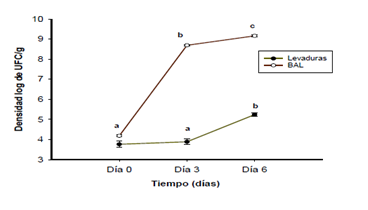
En este estudio se evaluó el efecto del tiempo de fermentación y días de almacenamiento sobre los atributos de textura en pan fermentado con masa madre. Se elaboraron panes de masa madre con diferentes tiempos de fermentación (4, 6 y 8 h a temperatura de 25 °C y 16 h a 4 °C). Fue utilizado un pan leudado con levadura como control. Se realizó el análisis microbiológico para conocer el contenido de bacterias ácido lácticas (BAL) y levaduras en la masa y el análisis de perfil de textura (TPA) en los panes, obteniendo una masa madre con 9.158 ± 0.06 log UFC/g de BAL y 5.239 ± 0.07log UFC/g de levaduras al día 6 de fermentación con un pH final de 3.83 ± 0.14. El TPArealizado en todas las formulaciones a diferentes días de almacenamiento, mostró un aumento estadístico significativo en los valores de dureza, cohesión, elasticidad y masticabilidad en las horas 8 y 16 de fermentación, así como en él día 4 de almacenamiento. En conclusión, el almacenamiento incrementa la dureza, elasticidad y mas esticabilidad en los panes de masa madre con un mayor tiempo de fermentación (8 y 16 h).
Detalles del artículo
Citas
Arendt, E. K., Ryan, L. A., & Dal Bello, F. (2007). Impact of sourdough on the texture of bread. Food microbiology, 24(2), 165-174. https://doi.org/10.1016/j.tifs.2004.02.010
Arora, K., Ameur, H., Polo, A., Di Cagno, R., Rizzello, C. G., & Gobbetti, M. (2020). Thirty years of knowledge on sourdough fermentation: A systematic review. Trends in Food Science & Technology, 108, 71-83.
Bottani, M., Brasca, M., Ferraretto, A., Cardone, G., Casiraghi, M. C., Lombardi, G., ... & Silvetti, T. (2018). Chemical and nutritional properties of white bread leavened by lactic acid bacteria. Journal of Functional Foods, 45, 330-338. https://doi.org/10.1016/j.jff.2018.04.030
Calvo-Carrillo, M. D. L. C., López-Méndez, O. X., Carranco-Jáuregui, M. E., & Marines, J. (2020). Evaluación fisicoquímica y sensorial de un pan tipo baguette utilizando harinas de trigo (Triticum spp) y chícharo (Pisum sativum L.). Biotecnia, 22(3), 116-124. https://doi.org/10.18633/biotecnia.v22i3.1227
De Vuyst, L., Harth, H., Van Kerrebroeck, S., & Leroy, F. (2016). Yeast diversity of sourdoughs and associated metabolic properties and functionalities. International Journal of Food Microbiology, 239, 26-34. https://doi.org/10.1016/j.ijfoodmicro.2016.07.018
Demirkesen-Bicak, H., Arici, M., Yaman, M., Karasu, S., & Sagdic, O. (2021). Effect of Different Fermentation Condition on Estimated Glycemic Index, In Vitro Starch Digestibility, and Textural and Sensory Properties of Sourdough Bread. Foods, 10(3), 514. https://doi.org/10.3390/foods10030514
Gobbetti, M., De Angelis, M., Di Cagno, R., Polo, A., & Rizzello, C. G. (2020). The sourdough fermentation is the powerful process to exploit the potential of legumes, pseudo-cereals and milling by-products in baking industry. Critical Reviews in Food Science and Nutrition, 60(13), 2158-2173. https://doi.org/10.1080/10408398.2019.1631753
Häggman, M., & Salovaara, H. (2008). Microbial re-inoculation reveals differences in the leavening power of sourdough yeast strains. LWT-Food Science and Technology, 41(1), 148-154.
Hammes, W. P., Brandt, M. J., Francis, K. L., Rosenheim, J., Seitter, M. F., & Vogelmann, S. A. (2005). Microbial ecology of cereal fermentations. Trends in Food Science & Technology, 16(1-3), 4-11. https://doi.org/10.1016/j.tifs.2004.02.010
Hayta, M., & Hendek Ertop, M. (2018). Evaluation of microtextural properties of sourdough wheat bread obtained from optimized formulation using scanning electron microscopy and image analysis during shelf life. Journal of food science and technology, 55(1), 1-9. 10.1007/s13197-017-2823-1
Katsi, P., Kosma, I. S., Michailidou, S., Argiriou, A., Badeka, A. V., & Kontominas, M. G. (2021). Characterization of Artisanal Spontaneous Sourdough Wheat Bread from Central Greece: Evaluation of Physico-Chemical, Microbiological, and Sensory Properties in Relation to Conventional Yeast Leavened Wheat Bread. Foods, 10(3), 635. https://doi.org/10.3390/foods10030635
Li, X., Guo, Y., Chen, L., Liu, K., & Gong, K. (2021). Texture and bio-functional characteristics of a Chinese steamed bread prepared from lotus root powder partially replacing wheat flour. Scientific Reports, 11(1), 1-7.
Maldonado-Astudillo, Y. I., Cantú-Guzmán, Á., Salazar, R., & Jiménez-Hernández, J. (2019). Análisis de perfil de textura de frutos partenocárpicos de mango cv. ‘Ataúlfo’. Revista mexicana de ciencias agrícolas, 10(5), 1175-1181.
Nasir, S., Allai, F. M., Gani, M., Ganaie, S., Gul, K., Jabeen, A., & Majeed, D. (2020). Physical, textural, rheological, and sensory characteristics of amaranth-based wheat flour bread. International Journal of Food Science, 2020. https://doi.org/10.1155/2020/8874872
Oshiro, M., Tanaka, M., Momoda, R., Zendo, T., & Nakayama, J. (2021). Mechanistic Insight into Yeast Bloom in a Lactic Acid Bacteria Relaying-Community in the Start of Sourdough Microbiota Evolution. Microbiology spectrum, 9(2), e00662-21. https://doi.org/10.1128/Spectrum.00662-21
Rizzello, C. G., Coda, R., Mazzacane, F., Minervini, D., & Gobbetti, M. (2012). Micronized by-products from debranned durum wheat and sourdough fermentation enhanced the nutritional, textural and sensory features of bread. Food Research International, 46(1), 304-313. https://doi.org/10.1016/j.foodres.2011.12.024
Wanjuu, C., Abong, G., Mbogo, D., Heck, S., Low, J., & Muzhingi, T. (2018). The physiochemical properties and shelf‐life of orange‐fleshed sweet potato puree composite bread. Food science & nutrition, 6(6), 155