
Bastón para Invidentes con Tecnología 4.0
Barra lateral del artículo
Contenido principal del artículo
Resumen
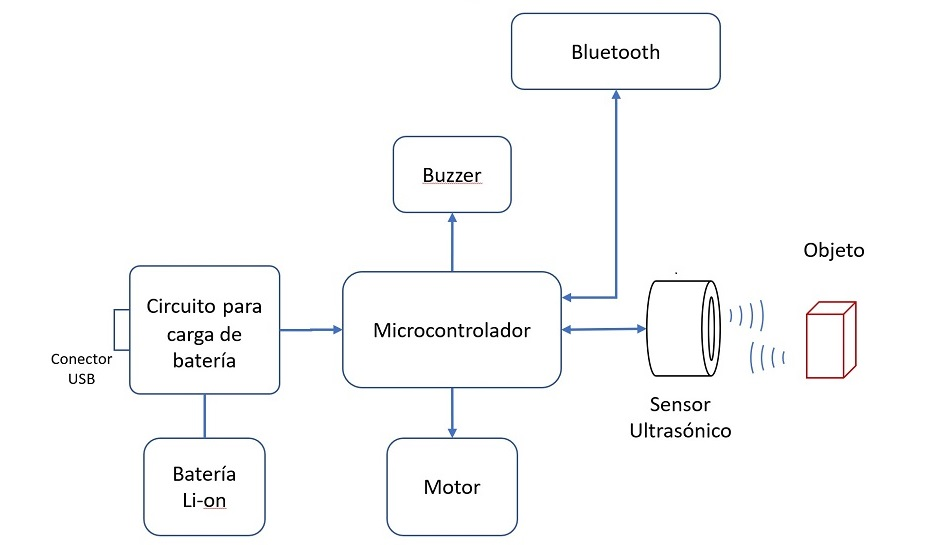
La revolución industrial 4.0 ha traído grandes progresos para las actividades del ser humano, sin embargo, estas nuevas tecnologías no deben excluir a las personas con discapacidades, sino por el contrario, deben aprovecharse para lograr herramientas que ayuden a superar las dificultades que enfrentan estas personas. En este documento se detalla un sistema para realzar las potencialidades de un bastón común para invidentes e integrarlo a esta revolución. El bastón utiliza un sensor ultrasónico para detectar objetos cuando una persona invidente camine en un ambiente exterior. Cuando un objeto es detectado, el sistema se lo indica al usuario por medio de una señal audible y una vibración. El sistema es alimentado por una batería de iones de litio y ocupa componentes comerciales de bajo costo. El sistema detecta cerca del 84% de los obstáculos en un ambiente de prueba y se puede usar por 2 horas.
Detalles del artículo
Citas
Álvarez, R. (2019). WeWalk, el bastón para invidentes equipado con Google Maps, altavoz y que se puede enlazar a un smatphone. Xataka. [https://www.xataka.com/wearables/wewalk-baston-para-invidentes-equipado-google-maps-altavoz-que-se-puede-enlazar-a-smartphone](https://www.xataka.com/wearables/wewalk-baston-para-invidentes-equipado-google-maps-altavoz-que-se-puede-enlazar-a-smartphone)
Dey, N., Paul, A., Ghosh, P., Mukherjee, C., De, R., & Dey, S. (2018). Ultrasonic Sensor Based Smart Blind Stick. Proceedings of the 2018 International Conference on Current Trends towards Converging Technologies, ICCTCT 2018, 1–4. [https://doi.org/10.1109/ICCTCT.2018.8551067](https://doi.org/10.1109/ICCTCT.2018.8551067)
Ghafoor, M. J., Junaid, M., & Ali, A. (2019). Nav-Cane A Smart Cane for Visually Impaired People. RAEE 2019 - International Symposium on Recent Advances in Electrical Engineering, 4, 1–4. [https://doi.org/10.1109/RAEE.2019.8886919](https://doi.org/10.1109/RAEE.2019.8886919)
Guimares, C. S. S., Henriques, R. V. B., & Pereira, C. E. (2016). Tracking System Proposal of Walking Sticks Aiming the Orientation and Mobility of the Visually Impaired. IFAC-PapersOnLine, 49(30), 161–166. [https://doi.org/10.1016/j.ifacol.2016.11.147](https://doi.org/10.1016/j.ifacol.2016.11.147)
Javaid, M., Haleem, A., Singh, R. P., Rab, S., & Suman, R. (2021). Significance of sensors for industry 4.0: Roles, capabilities, and applications. Sensors International, 2(June), 100110. [https://doi.org/10.1016/j.sintl.2021.100110](https://doi.org/10.1016/j.sintl.2021.100110)
Khafar, N. H. B. A., Soomro, D. M., Rahman, R. A., Abdullah, M. N., Soho, I. A., & Rahimoon, A. A. (2019). Intelligent Navigation System using Ultrasonic Sensor for Visually Impaired Person (VIP). ICETAS 2019 - 2019 6th IEEE International Conference on Engineering, Technologies and Applied Sciences, 6–9. [https://doi.org/10.1109/ICETAS48360.2019.9117297](https://doi.org/10.1109/ICETAS48360.2019.9117297)
Lopes, S. I., Vieira, J. M. N., Lopes, Ó. F. F., Rosa, P. R. M., & Dias, N. A. S. (2012). MobiFree: A set of electronic mobility aids for the blind. Procedia Computer Science, 14(Dsai), 10–19. [https://doi.org/10.1016/j.procs.2012.10.002](https://doi.org/10.1016/j.procs.2012.10.002)
Nakagawa, E. Y., Antonino, P. O., Schnicke, F., Capilla, R., Kuhn, T., & Liggesmeyer, P. (2021). Industry 4.0 reference architectures: State of the art and future trends. Computers and Industrial Engineering, 156(March), 107241. [https://doi.org/10.1016/j.cie.2021.107241](https://doi.org/10.1016/j.cie.2021.107241)
Organización Mundial de la Salud. (2020). Ceguera y Discapacidad Visual. [https://www.who.int/es/news-room/fact-sheets/detail/blindness-and-visual-impairment](https://www.who.int/es/news-room/fact-sheets/detail/blindness-and-visual-impairment)
Parikh, A., Shah, D., Popat, K., & Narula, H. (2015). Blind man stick using Programmable Interrupt Controller (PIC). Procedia Computer Science, 45(C), 558–563. [https://doi.org/10.1016/j.procs.2015.03.102](https://doi.org/10.1016/j.procs.2015.03.102)
Rajendra, A., & Tasgaonkar, P. P. (2016). Object recognition using horizontal array of ultrasonic sensors. International Conference on Communications and Signal Processing, 983–986. [https://doi.org/10.1109/ICCSP.2016.7754294](https://doi.org/10.1109/ICCSP.2016.7754294)
Sen, A., Sen, K., & Das, J. (2018). Ultrasonic Blind Stick for Completely Blind People to Avoid Any Kind of Obstacles. Proceedings of IEEE Sensors, October 2018. [https://doi.org/10.1109/ICSENS.2018.8589680](https://doi.org/10.1109/ICSENS.2018.8589680)
Shrivastava, A., Murali Krishna, K., Lal Rinawa, M., Soni, M., Ramkumar, G., & Jaiswal, S. (2021). Inclusion of IoT, ML, and Blockchain Technologies in Next Generation Industry 4.0 Environment. Materials Today: Proceedings. [https://doi.org/10.1016/j.matpr.2021.07.273](https://doi.org/10.1016/j.matpr.2021.07.273)
Sony, M., Antony, J., Mc Dermott, O., & Garza-Reyes, J. A. (2021). An empirical examination of benefits, challenges, and critical success factors of industry 4.0 in manufacturing and service sector. Technology in Society, 67. [https://doi.org/10.1016/j.techsoc.2021.101754](https://doi.org/10.1016/j.techsoc.2021.101754)
The International Agency for the Prevention of Blindness. (2020). Country map and estimates of vision loss. Age-std prevalence of all vision loss 2020. [https://www.iapb.org/es/learn/vision-atlas/magnitude-and-projections/country-estimates-of-vision-loss/](https://www.iapb.org/es/learn/vision-atlas/magnitude-and-projections/country-estimates-of-vision-loss/)