
White Cane with 4.0 Technology
Article Sidebar
Main Article Content
Abstract
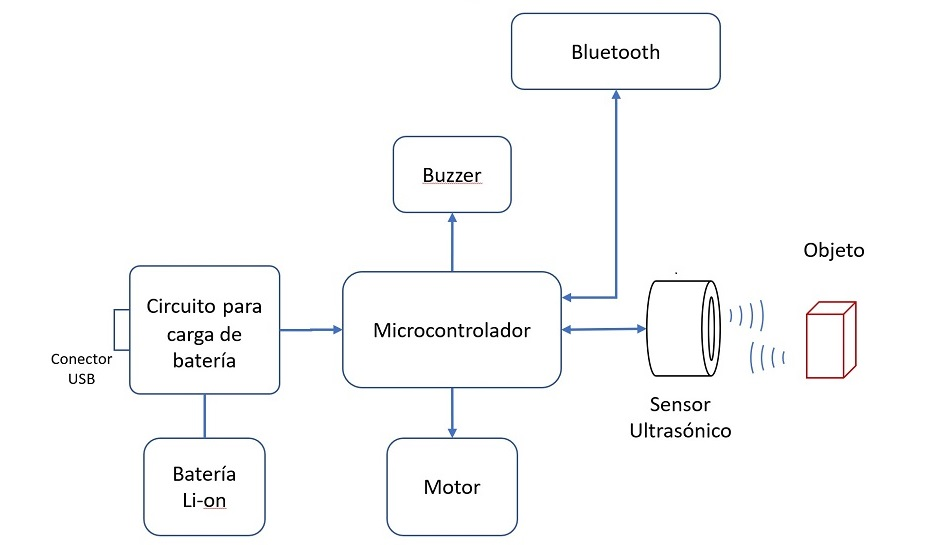
The industrial revolution 4.0 has brought great progress for human activities, however, these new technologies should not exclude people with disabilities, but on the contrary, they should be used to achieve tools that help overcome the difficulties they face. This document details a system to enhance the potential of a common cane for the blind and integrate it into this revolution. The cane uses an ultrasonic sensor to detect objects when a blind person walks in an outdoor environment. When an object is detected, the system indicates it to the user by means of an audible signal and a vibration. The system is powered by a lithium-ion battery and occupies low-cost commercial components. The system detects about 84% of obstacles in a test environment and can be used for 2 hours.
Article Details
References
Álvarez, R. (2019). WeWalk, el bastón para invidentes equipado con Google Maps, altavoz y que se puede enlazar a un smatphone. Xataka. [https://www.xataka.com/wearables/wewalk-baston-para-invidentes-equipado-google-maps-altavoz-que-se-puede-enlazar-a-smartphone](https://www.xataka.com/wearables/wewalk-baston-para-invidentes-equipado-google-maps-altavoz-que-se-puede-enlazar-a-smartphone)
Dey, N., Paul, A., Ghosh, P., Mukherjee, C., De, R., & Dey, S. (2018). Ultrasonic Sensor Based Smart Blind Stick. Proceedings of the 2018 International Conference on Current Trends towards Converging Technologies, ICCTCT 2018, 1–4. [https://doi.org/10.1109/ICCTCT.2018.8551067](https://doi.org/10.1109/ICCTCT.2018.8551067)
Ghafoor, M. J., Junaid, M., & Ali, A. (2019). Nav-Cane A Smart Cane for Visually Impaired People. RAEE 2019 - International Symposium on Recent Advances in Electrical Engineering, 4, 1–4. [https://doi.org/10.1109/RAEE.2019.8886919](https://doi.org/10.1109/RAEE.2019.8886919)
Guimares, C. S. S., Henriques, R. V. B., & Pereira, C. E. (2016). Tracking System Proposal of Walking Sticks Aiming the Orientation and Mobility of the Visually Impaired. IFAC-PapersOnLine, 49(30), 161–166. [https://doi.org/10.1016/j.ifacol.2016.11.147](https://doi.org/10.1016/j.ifacol.2016.11.147)
Javaid, M., Haleem, A., Singh, R. P., Rab, S., & Suman, R. (2021). Significance of sensors for industry 4.0: Roles, capabilities, and applications. Sensors International, 2(June), 100110. [https://doi.org/10.1016/j.sintl.2021.100110](https://doi.org/10.1016/j.sintl.2021.100110)
Khafar, N. H. B. A., Soomro, D. M., Rahman, R. A., Abdullah, M. N., Soho, I. A., & Rahimoon, A. A. (2019). Intelligent Navigation System using Ultrasonic Sensor for Visually Impaired Person (VIP). ICETAS 2019 - 2019 6th IEEE International Conference on Engineering, Technologies and Applied Sciences, 6–9. [https://doi.org/10.1109/ICETAS48360.2019.9117297](https://doi.org/10.1109/ICETAS48360.2019.9117297)
Lopes, S. I., Vieira, J. M. N., Lopes, Ó. F. F., Rosa, P. R. M., & Dias, N. A. S. (2012). MobiFree: A set of electronic mobility aids for the blind. Procedia Computer Science, 14(Dsai), 10–19. [https://doi.org/10.1016/j.procs.2012.10.002](https://doi.org/10.1016/j.procs.2012.10.002)
Nakagawa, E. Y., Antonino, P. O., Schnicke, F., Capilla, R., Kuhn, T., & Liggesmeyer, P. (2021). Industry 4.0 reference architectures: State of the art and future trends. Computers and Industrial Engineering, 156(March), 107241. [https://doi.org/10.1016/j.cie.2021.107241](https://doi.org/10.1016/j.cie.2021.107241)
Organización Mundial de la Salud. (2020). Ceguera y Discapacidad Visual. [https://www.who.int/es/news-room/fact-sheets/detail/blindness-and-visual-impairment](https://www.who.int/es/news-room/fact-sheets/detail/blindness-and-visual-impairment)
Parikh, A., Shah, D., Popat, K., & Narula, H. (2015). Blind man stick using Programmable Interrupt Controller (PIC). Procedia Computer Science, 45(C), 558–563. [https://doi.org/10.1016/j.procs.2015.03.102](https://doi.org/10.1016/j.procs.2015.03.102)
Rajendra, A., & Tasgaonkar, P. P. (2016). Object recognition using horizontal array of ultrasonic sensors. International Conference on Communications and Signal Processing, 983–986. [https://doi.org/10.1109/ICCSP.2016.7754294](https://doi.org/10.1109/ICCSP.2016.7754294)
Sen, A., Sen, K., & Das, J. (2018). Ultrasonic Blind Stick for Completely Blind People to Avoid Any Kind of Obstacles. Proceedings of IEEE Sensors, October 2018. [https://doi.org/10.1109/ICSENS.2018.8589680](https://doi.org/10.1109/ICSENS.2018.8589680)
Shrivastava, A., Murali Krishna, K., Lal Rinawa, M., Soni, M., Ramkumar, G., & Jaiswal, S. (2021). Inclusion of IoT, ML, and Blockchain Technologies in Next Generation Industry 4.0 Environment. Materials Today: Proceedings. [https://doi.org/10.1016/j.matpr.2021.07.273](https://doi.org/10.1016/j.matpr.2021.07.273)
Sony, M., Antony, J., Mc Dermott, O., & Garza-Reyes, J. A. (2021). An empirical examination of benefits, challenges, and critical success factors of industry 4.0 in manufacturing and service sector. Technology in Society, 67. [https://doi.org/10.1016/j.techsoc.2021.101754](https://doi.org/10.1016/j.techsoc.2021.101754)
The International Agency for the Prevention of Blindness. (2020). Country map and estimates of vision loss. Age-std prevalence of all vision loss 2020. [https://www.iapb.org/es/learn/vision-atlas/magnitude-and-projections/country-estimates-of-vision-loss/](https://www.iapb.org/es/learn/vision-atlas/magnitude-and-projections/country-estimates-of-vision-loss/)