
Engineering education: an approach from the prism of communities of practice
Article Sidebar
Main Article Content
Abstract
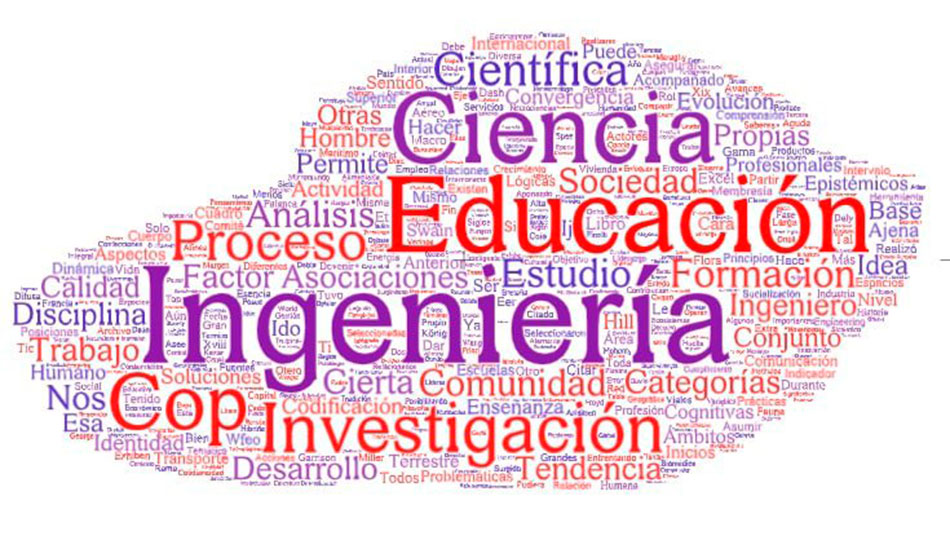
In this work, a study is carried out whose purpose is to know the thematic structure and main research objects in the field of engineering education, based on the codification of the titles of the works published in eight scientific journals whose only line is editorial engineering education in the period of time 2016-2021. The identified categories are presented in a network that those with scientific journals highlighting the absolute frequencies of citation. Based on the binary analysis (presence -1 / absence-0) in each journal, a study of similarity between the journals is carried out as an expression of the scientific production of communities of practice in engineering education, which allows evaluations to be made for the researchers of this scientific discipline.
Article Details
References
Abele, E., Metternich, J., Tisch, M., Chryssolouris, G., Sihn, W., ElMaraghy, H., ... and Ranz, F. (2015). Learning factories for research, education, and training. Procedia CiRp32, 1-6. https://doi.org/10.1016/j.procir.2015.02.187
Aslaksen, E. W. (2015). The relationship between engineers and society: Is it currently fulfilling its potential?. Journal and Proceedings of the Royal Society of New South Wales148(455/456), 28-43. https://doi/10.3316/informit.287380446130950
Bartolucci, J. (2017). La ciencia como problema sociológico. Sociológica (México) 32 (92), 9-40.
Bernhard, J. (2018). Engineering Education Research in Europe—Coming of Age. Eur. J. Eng. Educ43, 167–170. https://doi.org/10.1080/03043797.2017.1412854
Celis, J., and Duque, M. (2016). Factores que configuran las preferencias de empleo de los estudiantes de doctorado en ingeniería por la academia y la industria. Investigación y Desarrollo24(2), 355-385. https://doi.org/10.14482/indes.24.2.7706
Chavalarias, D., & Cointet, J. P. (2013). Phylomemetic patterns in science evolution—the rise and fall of scientific fields. PloS one8(2), e54847. https://doi.org/10.1371/journal.pone.0054847
Chávez J., (2021). Principales corrientes y tendencias a inicios del siglo XXI de la pedagogía y la didáctica. Editorial Pueblo y Educación. La Habana.
Coccia, M., and Wang, L. (2016). Evolution and convergence of the patterns of international scientific collaboration. Proceedings of the National Academy of Sciences,113(8), 2057-2061. https://doi.org/10.1073/pnas.1510820113
Díaz, M., Moya, F. D., and Carrillo, H. A. (2017). Técnicas para la visualización de dominios científicos y tecnológicos. Investigación bibliotecológica31, 17-42. https://doi.org/10.22201/iibi.24488321xe.2017.nesp1.57884
Fensham, P. J. (2004). Defining an identity: The evolution of science education as a field of research (Vol. 20). Springer Science and Business Media. Netherlands.
Finelli C., and Dalyu. S., (2015). Frequently Asked Questions Engineering Education Research Faculty Search October, Michigan Engineering Associate Dean for Academic Affairs. https://adaa.engin.umich.edu/wp-content/uploads/sites/22/2014/09/EER-FAQs.pdf. Consultado12 octubre de 2021
Froyd, J. E. and Lohmann, J. R. (2014). Chronological and ontological development of engineering education as a field of scientific inquiry. Cambridge Handbook of Engineering Education Research. https://doi.org/10.1017/CBO9781139013451.003.
Garrison, E. (2018). A History of Engineering and Technology Artful Methods: Artful Methods (2nd ed.). Routledge. doi.org/10.1201/9780203751749.
Graham, R. (2018). The global state of the art in engineering education. Massachusetts Institute of Technology (MIT) Report, Massachusetts, USA.
Gutiérrez, J. C. L., Pérez, I., and Aguirre, J. M. L. (2017). Didáctica universitaria: una didáctica específica comprometida con el aprendizaje en el aula universitaria. Dominio de las Ciencias3(3), 1290-1308.
Hill, D. (2013). A History of Engineering in Classical and Medieval Times (2nd ed.). Routledge. https://doi.org/10.4324/9781315800110.
Kezar, A., and Gehrke, S. (2017). Strategies for achieving scale within communities of practice aimed at pedagogical reform in higher education. Journal of STEM Education: Innovations and Research18(1). 57-64.
König, W. (2016). Education and Social Standing: German Engineers, 1870-1930. Quaderns d'història de l'enginyeria 15, 113-121.
Kosub, S., (2019). A note on the triangle inequality for the Jaccard distance, Pattern Recognition Letters. https://doi.org/10.1016/j.patrec.2018.12.007.
León, V. E. and y Herrera, J. L., (2014) Problemas epistemológicos de la didáctica: apuntes para el debate. Revista Atlante: Cuadernos de Educación y Desarrollo 52, 1-9.
Luchini, K., Colbry, D., Rojewski, J., and Briliyanti, A. (2019, January). Partners in Professional Development: Initial Results from a Collaboration Between Universities, Training Programs, and Professional Societies. InProceedings of the 2019 ASEE Annual Conference and Exposition.
Maraghy W. H. E. (2011). Future Trends in Engineering Education and Research. In: Seliger G., Khraisheh M., Jawahir I. (eds) Advances in Sustainable Manufacturing. Springer, Berlin, Heidelberg. doi.org/10.1007/978-3-642-20183-7_2.
Miller, D. P., (1993). The Engineers: A History of the Engineering Profession in Britain, 1750-1914. The English Historical Review 108 (427), 498 -500.
Mohanty, A., and Dash, D. (2016). Engineering education in India: Preparation of professional engineering educators. Journal of human resource and sustainability studies,4(2), 92-101.
Muñoz C. I., (2015). Metodología de la investigación. OXFORD. Editorial Progreso S.A de C.V. México. D. F.
Ortoll, E.; Canals, A.; Garcia, M. and Cobarsí, J. (2014). Principales parámetros para el estudio de la colaboración científica en big science. Revista Española de Documentación Científica37(4). https://doi.org/10.3989/redc.2014.4.1142.
Suasnábar, C. (2013). La institucionalización de la educación como campo disciplinar: Un análisis desde la perspectiva de la historia social de las ciencias sociales. Revista mexicana de investigación educativa18(59), 1281-1304.
Swain G.F. (1895). Addres by the President. Proceedings of the Third Annual Meeting. Springfield, Mass. September, 2-4. Published by the Society. University of Michigan
Viales R. J., (2017). La intersección entre ambiente, ciencia, tecnología y sociedad. Aproximaciones teóricas para su estudio desde la perspectiva CTS. San José, Costa Rica: Centro de Investigaciones Históricas de América Central
Wenger, E. (2007). All communities of practice need to find their 'spirit', which can be called their learning companionship. October 15-17, EU Conference "eLearning Lisboa 2007".